Contact Center AI · 2020 → today
In 2020, we were trying to make AI useful inside a contact center.
Sotoon already had ASR and NLP capabilities. The harder product question was what came next: how do you turn model output into a workflow a contact-center QA team will actually use?
I started working on this product problem in 2020. This is a modern interactive reconstruction of the product decisions behind that work, followed by how I would approach the same problem with today's AI capabilities.
Interactive reconstruction using synthetic data. No customer or confidential operational data is shown.
2020
ASR + NLP
Specialized capabilities were available.
Product work
QA review
The hard part was turning output into something a reviewer could use.
Today
Models + actions
The opportunity is larger, and so are the product consequences.
My Role
Product ownership, not model ownership.
01
Discover & focus
Customer discovery, market benchmarking, and initial product focus.
02
Define & design
MVP, success signals, reviewer workflow, and high-fidelity prototype.
03
Align & build
Roadmaps across contact-center, voice, NLP, and engineering.
04
Test & iterate
Customer MVP testing and feedback-led product releases.
05
Commercialize
Pricing and commercial work with sales and customer-facing teams.
The voice and NLP teams owned the models. I owned the productization: turning those capabilities into a product, an operating workflow, a validation plan, and a path to customers.
The 2020 Problem
A QA team could only review a fraction of its calls.
Quality monitoring was constrained by human attention. Reviewing a call took time, so the product problem was not simply “score calls with AI.”
Which calls deserve a reviewer's attention?
In the product research and planning behind this work, manual QA was commonly framed as reviewing roughly 5% to 20% of calls.
100 calls received
10 manually sampled
90 outside the manual review sample
Selection signals
Calls might be selected through a random sample, call duration, or an existing customer score.
Product opportunity
Use ASR and NLP to surface more of the calls worth reviewing.
The Product Decision
We did not start with full automation.
The broader vision included more ambitious contact-center automation. But a broad AI vision is not an MVP.
My bias was to find the first workflow where the AI capability could change an operating process, not just create an impressive demo.
Broad contact-center vision
Automatic answering · Outbound automation · Call classification · Monitoring and trends · Quality monitoring
Customer and market learning
Stakeholder conversations · Global product benchmarking · Prototype exploration · Operational workflow analysis
Initial focus
Quality monitoring
The pain already existed, the reviewer already had a job to do, and ASR/NLP capabilities could enter that workflow without requiring the entire contact center to change at once.
Interactive Reconstruction
A score was not a product.
The reviewer still needed to hear the call, read the transcript, understand the context, and continue the QA workflow.
Quality review workspace
Modern reconstruction of the historic workflow logic
Review queue
Billing explanation with visible customer frustration.
May 12, 2021 · Agent 42 · Synthetic customer A · Quality score: 82
Transcript
Customer
I called last week and still do not understand why this charge changed.
Agent
I can compare the current invoice with the previous one.
Customer
I need someone to explain it clearly, not read the same answer again.
Agent
You are right. The difference is connected to the plan change from May 12. I will summarize it and send the billing issue for review.
Analysis signals
Reviewer workflow
The system helps with
Transcription · Initial scoring signals · Call prioritization · Topic or pattern extraction
The reviewer decides
Final QA assessment · Score adjustment · Follow-up need · Coaching or operational action
The model changes what reaches the reviewer and what evidence is visible. The reviewer still owns the QA decision.
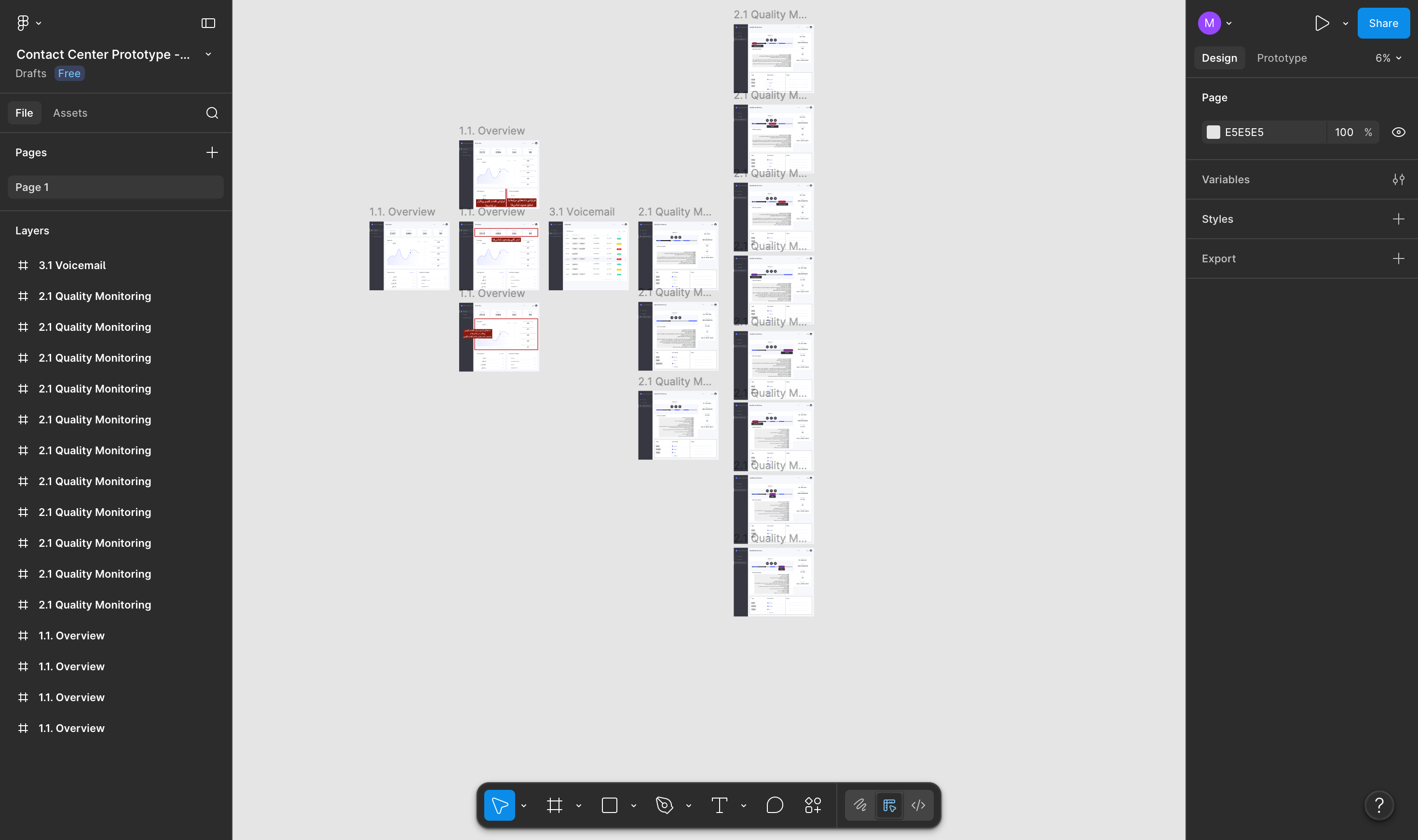
From the 2020 prototype
The original product interface was designed for Persian-speaking contact-center teams.
Product Decisions
Three decisions mattered more than the model demo.
Decision 01
Start with quality monitoring, not full automation
Quality monitoring presented a sharper problem, an existing user, and a faster route to an MVP. A broad AI capability becomes a product only after you choose the workflow where it earns the right to exist.
Decision 02
Put AI inside the review flow
A score returned by an API was not enough. The reviewer needed playback, transcript, call context, score, and the next review step in one place.
Decision 03
Measure the operating workflow
The product evidence had to move from model output to operating value. Could we process more calls? Could more relevant calls reach reviewers? Could scoring become more reliable?
Operating Evidence
The product moved beyond a prototype.
18K+
Daily calls
Handled through the ASR workflow
35%
Review / reporting throughput
Improvement in the operational workflow
2.15x
Call-scoring accuracy
Improvement
These are historical operating signals from my documented product work. The interface on this page is a synthetic reconstruction, not the original production system.
2020 → today
The model layer changed dramatically.
Current product reflection, updated July 2026.
The product question did not disappear.
In 2020, much of the work was about combining specialized ASR and NLP capabilities with a usable operational workflow. Today, modern models can interpret far more context, produce structured outputs, use tools, and in some systems take actions across software.
That expands the product opportunity. It also expands the consequences of a bad product decision.
01
Audio
02
ASR
03
Text and language processing
04
Quality or topic signals
05
Prioritized review queue
06
Human QA review
The system helps interpret and prioritize evidence before the reviewer acts.
One thing I would resist today is calling every intelligent workflow an agent.
If the system only classifies, scores, or summarizes, I would design it as a strong AI workflow. I would introduce agentic behavior only where tool use and multi-step action create real product value.
Observe / recommend / act
Autonomy should follow the consequence of the action.
Autonomy should be designed around the consequence and reversibility of the action, not around how impressive the model looks.
Observe
Useful AI does not need autonomy.
Example actions
What I Would Change Today
I would keep the reviewer's job at the center. I would change how the system handles evidence, uncertainty, and action.
Trace signals to evidence
Every important quality signal should point back to the transcript, audio segment, policy context, or workflow event that supports it.
Evaluate the queue, not just the model
I would measure whether the right calls reach reviewers, how often they correct the system, and whether the workflow removes work or creates more review.
Use agents only when action adds value
Classification, scoring, and summarization do not automatically need an agent. I would add tool use and multi-step action only where the workflow benefits from it.
Design correction before autonomy
If the system creates tasks, updates records, or routes work, correction and escalation should exist before more autonomy is added.
Looking Back
This is one of the product problems that stayed with me.
I started working on this product problem in 2020.
At the time, we were combining ASR and NLP capabilities with contact-center workflows. The model layer was difficult, but productizing it created a different set of questions.
Which workflow should we start with?
What does the reviewer need to see?
Where does the model output enter the job?
What do we measure when the demo is over?
The model capability is the beginning. The product starts when it changes a real workflow.
Related Thinking
From model output to product system.
My recent article, The Agentic AI Product Gap, looks at a more modern version of the same product tension.
Once AI moves from interpreting work to taking action, workflow fit, evaluation, human control, monitoring, and recovery become part of the product itself.
“An agent is not ready when the model looks smart. It is ready when the workflow can absorb its mistakes.”
Continue The Conversation
The part I enjoy starts after the model works.
Choosing the workflow, testing it with users, earning adoption, and measuring what actually changed.